Archie Coombes
Sometimes in the field of archiving and school history, a request from someone for information can result in new material from the inquirer being added to the archives! Such a thing has occurred recently when Sally Callaghan requested some material relating to her grandfather, Mr A. J. Coombes, who was Headmaster of The Scots College Branch School 1942-1945. Ms Callaghan has provided us with some information that we did not have before. In this week where we celebrate the 80th anniversary of the foundation of The Scots School in 1946, it seems fitting that the article is about the man who effectively set up the operational and practical side of the school in the three and a half years he headed the Branch School before it transitioned into a new school in its own right.
Our new knowledge: Mr Coombes has now acquired the given name of Archie James. He was born in Coolah, NSW, on 27 April 1878. His father, William Nunn Coombes, was a teacher, and Archie was educated at Coolah and Cassilis Public Schools. The family then moved to Newcastle, where Archie attended Mosquito (or Moscheto) Island Public School. The island was the first of a chain of seven islands that ran between the North and South Arms of the Hunter River, from Hexham and Tomago downstream to Stockton and Port Waratah. It has now been incorporated into Kooragang Island, and Moscheto Island forms part of the Kooragang Wetlands. People familiar with Hexham Grey mosquitos will appreciate how it got its original name! Members of the Coombes family always joked about this!
Archie Coombes was evidently impressed by his father’s teaching career and pursued the same vocation. A number of his 15 siblings also became teachers. In 1895-1896 he is recorded at Tighes Hill Public School as a pupil teacher. The career path for school teachers at the time was to gain a position as a pupil teacher at a school, then train on the job to qualify for a permanent position. He moved to Sydney and held a number of teaching positions there. He appears to have been highly regarded enough to be appointed to the staff of the Fort Street Public School, then located on its old site on Observatory Hill. The school held the status of a Superior Public School, and employed the best the teaching profession had to offer. It has been a selective school for much of its history. Whilst employed at Fort Street, Coombes completed a Bachelor of Arts (Honours) degree at Sydney University, graduating in 1905.
From 1908, he was in New Zealand where he held a number of positions on the North Island, settling first at Gisborne. In New Zealand, he met his Australian-born wife Ruby, who was visiting relatives in New Zealand at the time. He and Ruby were parents to sons Arthur, Brian and Colin who had all reached adulthood by the time Archie arrived in Bathurst. He served as Acting Rector of St Andrew’s College, Christchurch before he and Ruby returned to Australia in 1920. His successor in this position was Alexander Knox Anderson, who in 1942 was Headmaster of Scots in Sydney.
On his return to Australia, he worked for a time as an Assistant Master at Maitland High School from 1921, then as English Master at Newcastle High School, 1925-1928. He returned to Sydney where he was English Master at Sydney Technical High School until 1931. It was whilst in this position that he published his first book in 1930, Notes On Coleridge’s Ancient Mariner, which was a guide to students studying for the Intermediate Certificate. He appears to have retired from the classroom at the end of 1931, but continued to be involved in education. In 1930 he published Representative English Poems. Again, this seems to have been a school textbook. In 1938, the Australian Sesquicentenary Celebrations Council held an extended literary essay competition that Archie Coombes entered, and won First Prize. His essay was published that year as Some Australian Poets. There is also an American edition on Internet Archive, scanned from a copy held in the Saratoga City Library! For the next four years, he lived at various addresses in Sydney in a state of semi-retirement. It is known that he worked as a pie maker in some city bakeries to supplement his income.
In 1942, at the age of 64 years, a new challenge beckoned. Mr Hedley Palmer, who had been sent to Bathurst by The Scots College, Bellevue Hill to head the Branch School, was called up for military service after only three months. An unsourced story relates that Rev. Alan Dougan, the Presbyterian Minister in Bathurst, heard about Archie Coombes from his contacts in the church. The Headmaster at Scots Sydney at the time was the same Alexander Knox Anderson who had taken over from him at St Andrew’s Christchurch. Archie Coombes was asked to take on the Headship of the Branch School and accepted. His story at the time was not unusual. People who attended school during the war years commented that many of the younger men had been called up for war service, and their places were often filled by older men who stayed on after retirement age to keep schools and other organisations running during the war.
Mr Coombes wife, Ruby, did not accompany him to Bathurst, and the family report that she stayed in Sydney. Although she may have visited, Colin Davidson mentions that in 1945 boys who had been good were invited to afternoon tea with her and Mr Coombes. Sally Callaghan has also mentioned an occasion when her Uncle Brian Coombes and his wife Margaret visited The Scots School and had afternoon tea with some of his former students.
In late 1945, the search for a Headmaster commenced for Scots School Bathurst (SSB. It became The Scots School a few years later). The position was first offered to Archie Coombes, but by 1945 he was 67 years old. The minutes of The Scots College Branch School Advisory Committee (soon to become the Council of Scots School Bathurst) record that he declined the position and that the Branch School closed at the end of 1945. He moved back to Sydney. It is known that by late 1945, he was in declining health. The following year he was admitted to Sydney Hospital, and died there on November 9 1946.
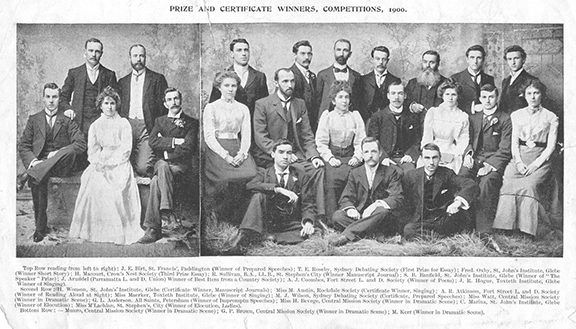
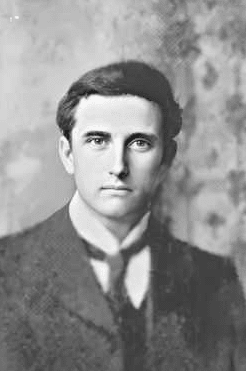
The Betty Ives collection has some photographs of Archie Coombes from his time in Bathurst. Sally Callaghan has found one other taken in 1900 when he won a literary award, representing Fort Street.
Mr Andrew Maher
Archives
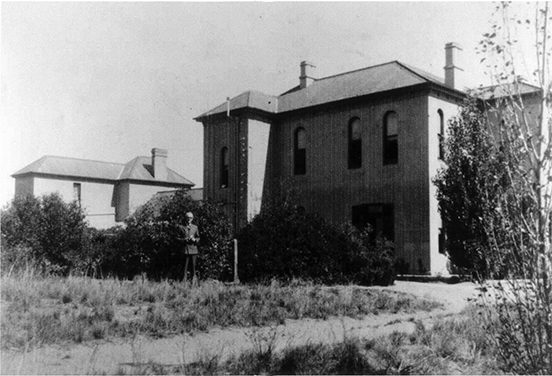
Photo 1: A photo from the 1944 prospectus for The Scots College Branch School with Mr Archie Coombes standing beside Karralee. This photo has been published often over the years.
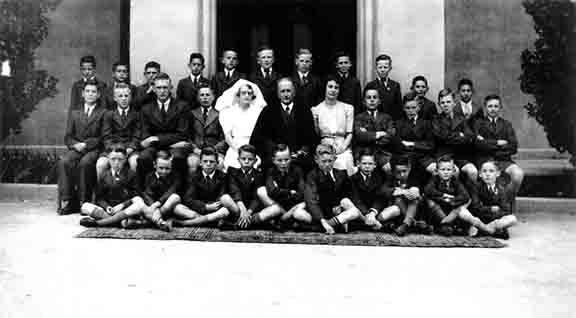
Photo 2: A photo of the boarders taken in 1945, which has not been published very often before. It comes from a portfolio of material compiled by George Rowlands and Allan Edgar. (Back Row – Left to right) John Silk, Tony Sperling, Colin Davidson, Leon Salon, John Brown, Martin Bolger, Hedley Taylor, John Rutherford, John Tinworth, Jeremy Trevor-Jones, Sam Goldstein. (Seated Row – Left to Right) Ray Bremner, Alwyn White, John Poynten, Ray Learmont, Miss F Missing, Mr A J Coombes, Miss B Phemister, Ron Gamack, Alec Bruce, David Cox, Max Howe. (Front Row – Left to Right) Bruce Bathgate, Stan Piesley, Tim Hector, Ian Bathgate, John Cobby, Allan Edgar, Mark Crossing, Philip Jacobson, David Russell, Lionel Tinworth.
Photo 3: A photo supplied by Sally Callaghan which shows the winners of a school Literature and Drama competition from 1900. Archie Coombes, then aged 22 years, is in the back row second from right, representing Fort Street in Poetry.
Photo 4: Detail of Archie Coombes from the 1900 photo.